Hygiene components
Topsheet, acquisition, distribution and backsheet-adjacent materials require different combinations of fluid strike-through, rewet, softness, tensile, basis weight and bond behavior.
Compare layer function, challenge method, conversion and finished-product boundary.
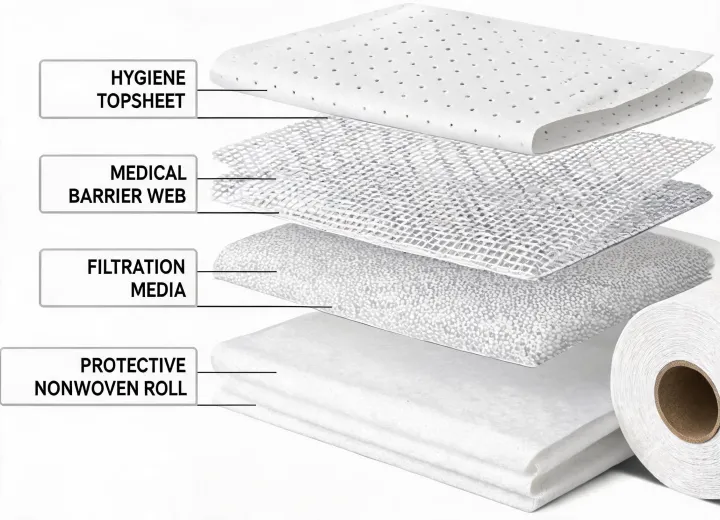
Topsheet, acquisition, distribution and backsheet-adjacent materials require different combinations of fluid strike-through, rewet, softness, tensile, basis weight and bond behavior.
Barrier, cleanliness, linting, comfort and sterilization compatibility may be relevant, but a material is not automatically a finished medical device or compliant product.
Efficiency, pressure drop, loading, particle or liquid challenge, electrostatic treatment and support layers must be evaluated using the intended test and system geometry.
Liquid resistance, breathability, abrasion, seam or bond construction and movement interact. Product-level protection requires an applicable finished-system method.
| Decision | Potential benefit | Limitation | Verification |
|---|---|---|---|
| Lower basis weight | Less material and possible softness or drape change. | Uniformity, strength, barrier or conversion stability may change. | GSM distribution, tensile, functional method and line trial. |
| Smaller pore / denser barrier | May support a defined liquid or particle challenge. | Pressure drop, breathability, flexibility or cost can change. | Challenge efficiency and pressure or vapor method together. |
| Hydrophilic treatment | Can support fluid acquisition or wetting. | Durability, migration, rewet and storage behavior require review. | Treatment level, aging, strike-through and rewet methods. |
| Electrostatic filtration | Can contribute to capture under a defined challenge. | Humidity, loading, aging and handling can affect the result. | Efficiency and pressure drop before and after relevant conditioning. |
No option is universally preferable. Polymer, fiber diameter, layer sequence, basis weight, treatment, challenge method and finished construction determine applicability.
Conversion can change the system. Heat or adhesive bonding, embossing, slitting, folding, sealing, sterilization, storage and adjacent layers may affect pores, tensile behavior, fluid paths or electrostatic charge. Prototype and line trials supplement flat-web results.
Production release identifies the ordered construction, treatment and lot. One web, basis weight or conditioning state does not automatically represent another.
Send function, adjacent materials, challenge, conversion, quantity and destination.